
SELECTED EXHIBITION
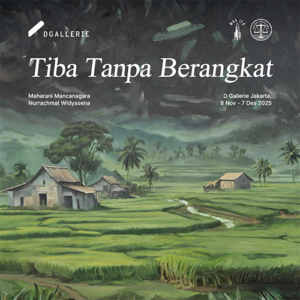
Tiba Tanpa Berangkat
DGallerie
Jakarta Indonesia
2025
08 November - 07 December
ABOUT THE SHOW
The history of knowledge production in Indonesia reveals a hierarchical relationship between subject and object: those in power produce and claim knowledge, while others are rendered as its source and simultaneously as the exploited. From the colonial era to the New Order, from the establishment of botanical gardens to state research institutions in the postcolonial period, knowledge was never produced in a neutral space. It was generated and disseminated within structures of power that shaped how we understand nature, science, technology, and the future.
The exhibition Tiba tanpa Berangkat (Arriving without Departing) departs from this awareness—that knowledge in Indonesia has always been shaped by the interrelations between science, the state, and imagination. The title refers to a paradoxical condition that has long shadowed the history of knowledge production in this country: we seem to have arrived at the promised future without ever truly departing from the lingering past.
The works of Maharani Mancanagara and Nurrachmat Widyasena reveal two interwoven temporal directions. Mancanagara traces the colonial roots of knowledge, while Widyasena looks toward the ever-delayed horizon of the future.
Chabib Duta Hapsoro
On the Edge I See Yellow
Warin Lab
Bangkok Thailand
2025
16 August - 04 October
ABOUT THE SHOW
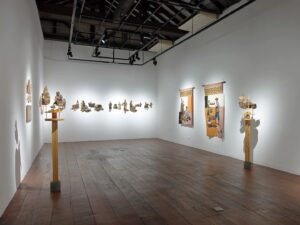
In On The Edge, I See Yellow, Maharani shifts her lens away from the direct representation of violence and toward acts of care, healing, and quiet resistance. Her practice evolves—not by abandoning history, but by approaching it from a different vantage point. Here, healing is political, and care becomes a method of archival recovery. Turmeric—yellow, familiar, and persistent—emerges as a central motif: a rhizome that crosses boundaries between the domestic and the historical, between the botanical and the embodied.
While her other works engaged directly with the ruptures of 1965, Maharani’s interest in this series lies in how those ruptures are remembered and sustained within the intimate sphere—especially through the often-overlooked labor of women. Memory, in this context, is not confined to state archives or official documentation. It resides in kitchens, in gestures of care, in inherited recipes, and in the healing rituals passed down through generations. She reconceptualizes the archive as something embedded in the body—a living, breathing repository of knowledge formed through repetition, ritual, and survival.
This exhibition expands that inquiry into the deeper colonial structures that have shaped land, labor, and health in Indonesia. Maharani investigates the long shadow of the 19th-century Dutch cultuurstelsel (cultivation system), a forced agricultural policy that not only extracted economic value but also transformed social hierarchies and marginalized indigenous knowledge systems. Turmeric, once again, becomes a point of departure: a plant that persisted despite extraction and erasure. It serves here not only as a healing agent or culinary spice, but as a witness to histories of forced labor, medical repression, and ecological displacement.
Artjog : Motif Amalan
Jogja National Museum
Yogyakarta Indonesia
2025
20 June - 31 August
ABOUT THE SHOW
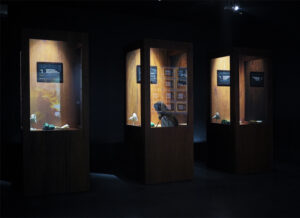
Maharani presents a telephone booth in the middle of a vast, silent room—a place where a conversation that’s supposed to be impossible becomes existent. Inside the booth, a chair and a classic corded telephone stand as silent witnesses to a meeting between two generations: a survivor of the 1965 tragedy and his granddaughter in the present day. When the receiver is lifted, a voice from the past weaves through, recounting arrests, interrogations, forced labor, and the lingering fears and hopes from Buru Island. Yet outside the booth, silence is the only presence—a void symbolizing erased memories, suppressed history, and stifled voices.
This installation invites us not only to listen but also to experience how history continues to seek its path to be told. The silence surrounding the booth becomes a symbol of resistance, reminding us that suppressed memories tend to echo louder. This never-ending dialogue becomes a call for the present generation to comprehend, remember, and carry on the stories of those who have been silenced. Paturon Ing Lelayu is not merely a journey of remembrance but also a moment of reflection: how can we ensure that these voices do not dissipate in silence?
The telephone inside the booth is not merely a tool of communication but a metaphor for how the past constantly attempts to speak to the present. The dialogue continues not only between the two characters in this work but also between the visitors and their own thoughts.
Indian Ocean Triennial Australia : Codes in Parallel
Fremantle Art Centre
Fremantle Australia
2024
01 August - 01 October
ABOUT THE SHOW
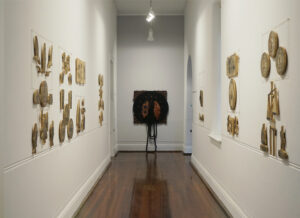
Growing up with two different cultural personas, Javanese and Sumatran, Maharani’s childhood was heavily influenced by Indonesia’s cultural variety. Folklore was more than simply bedtime stories; it conveyed hope, wisdom, and moral advice, transforming us into better people. One such story, Malin Kundang from West Sumatra’s Minangkabau culture, taught excellent lessons about many aspects of life.
This story is typically told to children so that they will grow up to be devoted to their parents, honor and love the mother who gave birth to them, work hard, never give up, seek knowledge as far as possible, not be selfish, accept themselves as they are, and not need to be someone else, among other moral lessons.
A similar story appears in Malaysian and Brunei Darussalam folklore under various names: Si Tanggang (or Megat Sejobang) in Selangor and Nahkoda Manis in Brunei Darussalam. The three folklore stories from three different countries share similar themes but differ in their endings and artifacts (stone inscriptions).
These stories, based on the social objectives, traditions, and lessons, resonate throughout generations, demonstrating shared ideals amidst culturaldifferences. The connections between these Malay folklores emphasize the long-term impact of migration, where traditions communicate with new circumstances. Migration forces us to adapt and grow while maintaining our distinctiveness, but history frequently represents a single viewpoint. Is there a deeper reason behind Malin, Tanggang, and Nahkoda’s actions?
This series of artworks represents an individual’s freedom to interpret history. Malin, Tanggang, and Nahkoda provide fresh insights into their hardships away from home. It encourages us to explore other people’s perspectives and challenges the idea of a single narrative. This exploration shows the complexities of human experiences and the interconnection of cultures, emphasizing the significance of empathy and understanding in our collective journey.
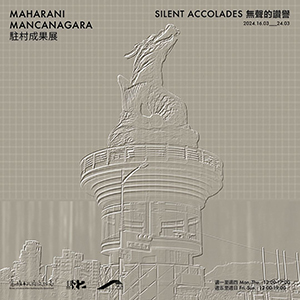
Silent Accolades
Pier-2 Art Center
Kaohsiung Taiwan
2024
16 - 24 March
ABOUT THE SHOW
Much like Indonesia, Taiwan has a deep history marked by colonialism. Positioned in the vast sea, the island attracted many nations seeking trade and power.
The Silent Accolades project began with immersive journeys exploring Taiwan’s history. Maharani started this adventure by visiting sites full of historical importance, tracing the footsteps of the past and some archives.
At the core of this effort is a careful look at historical records, unveiling Taiwan’s past blending with Indonesia’s intricate reality. Silent Accolades not only represents a quiet reflection but also takes shape through experiences on this important journey—a key for Maharani in understanding Taiwan’s evolution from the past to the present, breathing life into the pages of history.
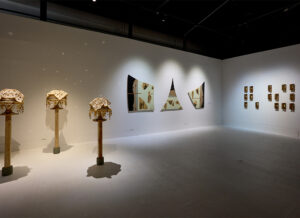
Body, Community, Society : She is House
333 Gallery
Bangkok Thailand
2023
03 June - 02 July
ABOUT THE SHOW
As the title implies, the exhibition explores the different insights into the word ‘body’ – both physical and architectural, as form and habitat – to illustrate the relation between the body and vernacular cultures and traditions in Indonesia. In particular, but not exclusively, the exhibition focuses on gendered bodies, bodies that are oftentimes excluded or accorded minor narratives but that are part of the same cycle of life. Situated along this line of thought is the proposition She is House, a prompt to consider the house as a site of birth and return, a ritualistic space of existence.
Departing from this premise, the exhibition functions as a platform for the works of four artists, Mella Jaarsma, Maharani Mancanagara, Citra Sasmita, and Natasha Tontey, to examine the intersections between body, gender and power in Indonesian societies, and to observe how traditional cultures are preserved, challenged or, ultimately, changed. Of utmost relevance, in fact, are the places of birth or cultural reference of the four artists: Java, Bali, North Sulawesi and West Sumatra. Known for their historical importance, each of these islands and local cultures foregrounds diverse belief systems and spiritual practices in which matrilineal narratives run in parallel to patriarchal ideology.
From mixed-media and video installations to painting and performance, the works presented in She is House engage with the ways in which cultural behaviours are formed in local traditions and examine the significance of rituals and communal practices in reinforcing or dismantling those same behaviours. By expanding the notion of the body to that of a home, a body of people or a body of knowledge, the works question the formation of social hierarchies, the transformation of cultural knowledge and the possibility of new knowledge that evolves from the embracement of otherness.
Loredana Pazzini-Paracciani
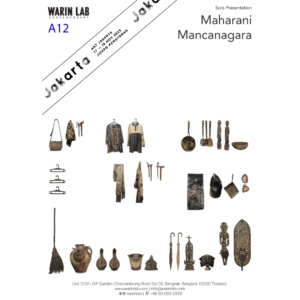
Testimonial Objects
Warin Lab at Art Jakarta 2023
Jakarta Indonesia
2023
17 - 19 November
ABOUT THE SHOW
Historical narratives are constantly competing to accomplish “official history” or to counter it. The museum is one of the contested zones represented by this cabinet of curiosities. The exhibition focuses on the topic of repatriation in Indonesia, which is now in the process of returning historical Indonesian artifacts from several Dutch museums. While repatriation is undoubtedly a crucial activity, concentrating solely on it risks reducing historical contestation to just a matter of ownership claims.
In the display, a few selected objects from the collection of the National Museum of Indonesia are replicated using recycled wood. It illustrates how ownership changes continually transform and revitalize the objects’ meanings. The object acquisition process by museums is also rife with the affirmation of stories, many of which hide the terrible situations those artifacts witnessed in silence. The cabinet of curiosities induces a rigorous study to trace objects’ migration through ownerships and modifications as the essential condition of repatriation.
When we look closely, some everyday objects are juxtaposed with the collections, most of which are valuables from the Nusantara, suggesting they are equal. This equalization criticizes the nationalist historical narrative of the public museums. The feudal middle-class narratives still dominate national history and marginalize grassroots narratives. This work addresses how museums might serve as platforms for forming critical knowledge that goes beyond perpetuating historical anecdotes of triumphs.
Chabib Duta Hapsoro
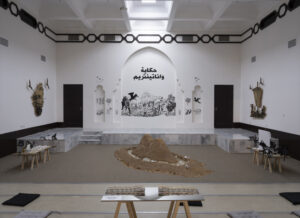
Sharjah Biennial 15 : Think Historically in Present
Khorfakkan Art Centre
Sharjah United Arab Emirates
2023
07 February - 11 June
ABOUT THE SHOW
Tacit
Artsphere Gallery
Jakarta Indonesia
2022
21 May - 21 June
ABOUT THE SHOW
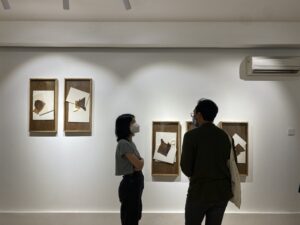
Materiality in art is never just about substances or surfaces—it reflects the ideological choices that shape an artist’s practice. Materials carry histories, imaginations, and metaphors; they structure how a work begins, unfolds, and communicates. In this exhibition, Maharani Mancanagara and Meliantha Muliawan explore material experimentation as both a conceptual method and an ethical stance.
Responding to the urgency of environmental concerns and the problem of waste in artistic production, both artists step away from the materials that have long defined their practices. Their search for more responsible approaches led them to misel, a newly developed cellulose sheet made from spent coffee grounds at the Institut Teknologi Bandung. By adopting this biodegradable, science-driven material, the artists enter a space of transition—one that nurtures new forms, new processes, and new imaginaries.
Meli reconfigures everyday objects through distortion and reconstruction, using misel to imitate wooden frames and tree segments, inviting reflection on the future of our vanishing natural materials. Maharani reworks discarded wood from her studio and experiments with abstraction, collage, and gesture, allowing forms to speak without predetermined narrative. Her misel-based hand sculptures and analogue moving-image devices open a tactile, intimate encounter with material and memory.
Together, their works propose materiality not as a passive component, but as a living collaborator—one that holds environmental critique, poetic possibility, and the courage to imagine different futures. This exhibition marks a shared shift toward responsible making, cross-disciplinary dialogue, and the generative unknown of new material worlds.
Alia Swastika
Distrik Seni : Berkelanjutan!
Sarinah
Jakarta Indonesia
2022
10 September - 24 November
ABOUT THE SHOW
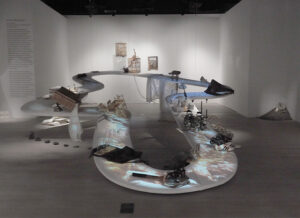
One measure of human civilization can be traced to our earliest attempts to transform natural materials into objects—whether functional tools or forms that carry personal and social meaning. Each object passes through a chain of processes, yet this chain is rarely complete or circular. In Sasana Gelung (2022), Maharani Mancanagara reflects on this imperfect cycle, revealing the shifting tensions between raw material, use, and the imagined life of things. Residues and offcuts from production—often dismissed as waste—become sources of both difficulty and possibility. In Maharani’s practice, these remnants reappear as objects that echo the functional world, their roles shaped as much by the viewer’s imagination as by their material form.
Through an installation resembling the remnants of a room encircling a quiet, spiraling core, Maharani gently unravels our assumptions about how objects live, decay, and transform. Educated in Bandung and active across national and international art platforms, she presents Sasana Gelung as a contemplation on the sustainability of everyday making. The work considers how production cycles extend beyond economic systems, touching deeply on the social and political conditions that shape how we inhabit, value, and ultimately understand the things around us.
Bob Edrian
